At Decon Solutions Australia, understanding the difference between cleaning and decontamination is essential for maintaining safe environments. Cleaning is the process of removing visible dirt, dust, and other debris on the surface, whereas decontamination cleaning is the process of removing harmful bacteria, viruses, and other threatening chemicals. The latter process is significant in the industrial facility, laboratory, and healthcare environment, in which contamination may be a critical issue.
The businesses that need the services of decontamination cleaning in Australia usually have to handle the environment in which regular cleaning cannot possibly remove the dangerous chemicals and provide the workers with safety.
Key Takeaways
- Cleaning: Removes visible dirt, dust, and debris from surfaces.
- Decontamination: Goes beyond cleaning to remove hazardous biological or chemical contaminants.
- Sanitizing: Reduces germs to safe levels but may not kill all microorganisms.
- Disinfecting: Kills many harmful microorganisms to prevent the spread of disease.
- CDC Guidance: Cleaning should always be done before sanitizing or disinfecting to ensure effectiveness.
What is Decontamination Cleaning?
Decontamination cleaning refers to the removal or neutralisation of dangerous contaminants of the surface or environment, e.g., chemicals, bacteria, viruses, or toxins. In contrast to a cleaning routine, which is concerned primarily with dirty things that can be seen, decontamination aims at the invisible threats to human health.
Specialised equipment, cleaning agents, and protective procedures are used to carry out the process of decontamination cleaning by professionals to make sure the contaminants are eliminated harmlessly. This can involve surface treatment, chemical neutralisation, air filtration, and verification testing.
In Australia, decontamination cleaning services are commonly used in industries that require the use of safe and compliant workplaces, such as in healthcare, manufacturing, laboratories, and waste management.
The Difference Between Cleaning and Decontamination
Three popular steps in the maintenance of hygiene are cleaning, sanitizing, and disinfecting. Physical cleaning involves the removal of dirt, germs, and impurities from surfaces using soap or detergents with water, and must be frequently done, followed by sanitizing or disinfection.
Sanitizing involves the reduction of the germs present on surfaces to reasonable levels with less strong solutions of bleach or sanitizing sprays, and is imperative for surfaces that are touched by mouths or food.
Remaining germs on surfaces are killed by disinfection with stronger bleach solutions or disinfectants registered bythe EPA, and it is especially necessary when an individual is ill or at high risk. All the steps are important towards making the surrounding environment safe and clean.
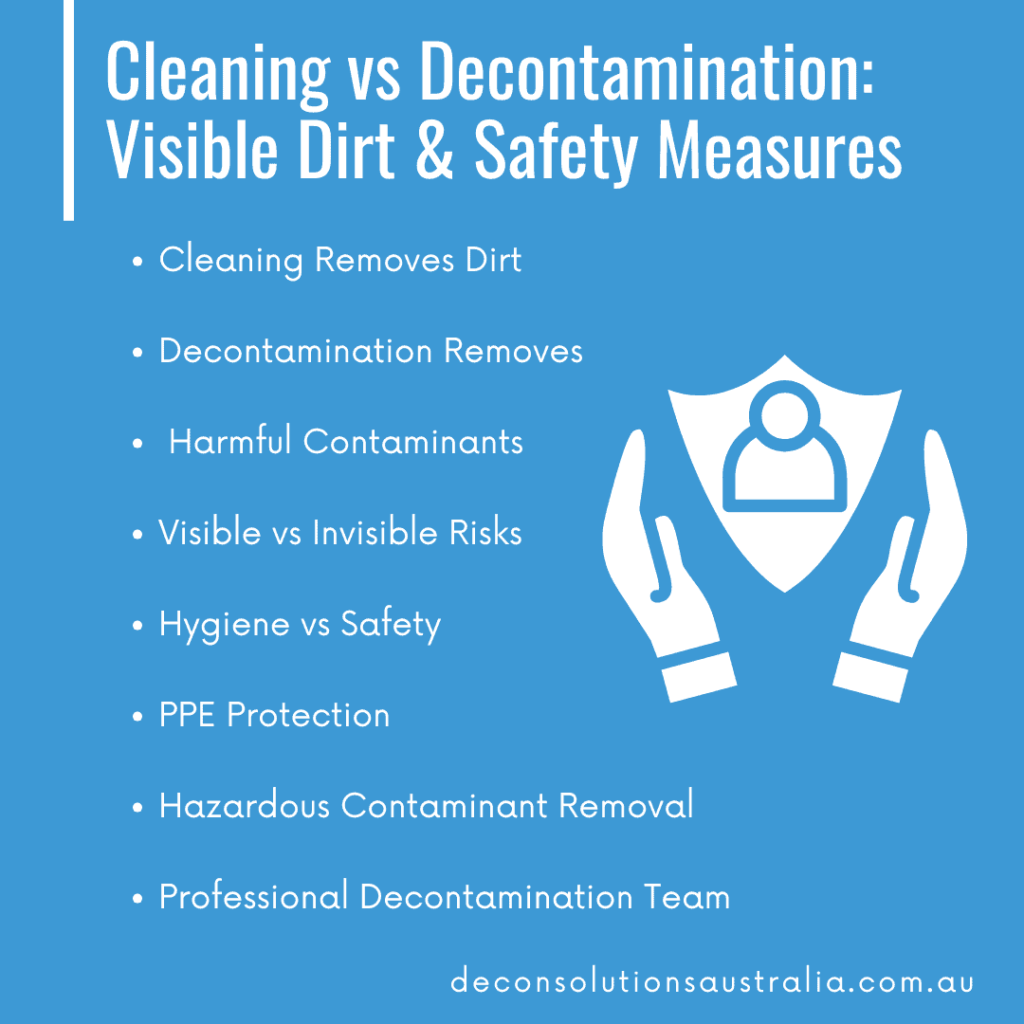
Understand the difference: cleaning vs decontamination. We remove invisible risks and hazardous residues to ensure property safety.
Difference Between Cleaning, Sanitizing, and Disinfecting
Cleaning involves the removal of dirt and organic matter on the surface with the help of soap or detergent and water. The process reduces the amount of germs, but it does not always kill the germs.
Sanitizing can eliminate microorganisms to levels that are regarded as being safe by the standards of public health. It is usually applied in food preparation areas where surfaces need to comply with hygiene standards.
In disinfection, the chemical agents used are stronger to eliminate bacteria, viruses, and other microorganisms on the surface. The procedure is mostly applied in healthcare organizations, laboratories, and high-risk settings.
According to the Centers for Disease Control and Prevention (CDC), one should always clean before sanitizing or disinfecting, since dirt may diminish the power of disinfectants.
Sanitizing vs Disinfecting
Understanding sanitizing vs disinfecting helps organisations select the correct hygiene method.
Sanitizing eliminates bacteria and microorganisms to acceptable levels as per the standards of health stipulated by the public. It is also commonly applied in kitchens, restaurants, and food processing plants. The benefit of sanitizing is that it is used to contain germs faster with the use of softer chemicals. Nonetheless, it might not remove all the detrimental pathogens.
Disinfection is the application of stronger chemical agents that destroy microorganisms that are disease-causing on surfaces. It is widespread in health care facilities and risky workplaces. Although disinfecting is very successful, it should be properly applied, and safety should be observed.
Cleaning, sanitizing, and disinfecting all constitute part of an excellent decontamination cleaning plan.
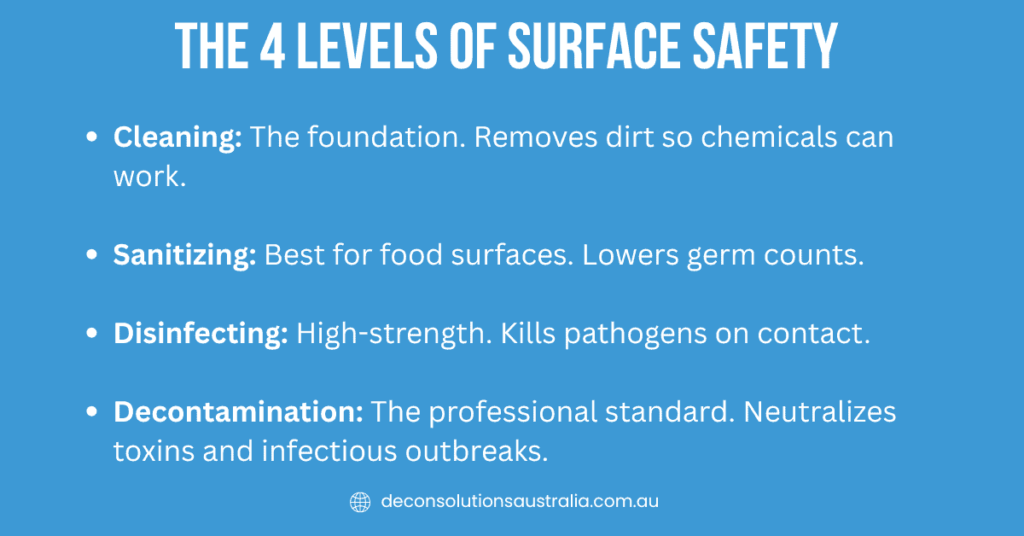
From cleaning to decontamination, we provide the highest level of surface safety to neutralize toxins and infectious outbreaks.
Statistics and Guidelines
CDC Guidance: Always clean the surfaces before sanitizing or disinfecting, as dirt may reduce the disinfectant effectiveness.
Chemical Safety: Follow the instructions for dilution, contact time, and PPE use.
Industrial Safety: Workers should wear gloves, masks, goggles, and protective clothing to ensure proper ventilation when handling hazardous substances.
Home Safety: Regularly clean high-touch areas, store chemicals safely, and never mix cleaning agents.
Verification: Swab tests or monitoring can confirm the effective decontamination in high-risk environments.
Impact: Proper cleaning, sanitizing, and disinfecting end up reducing disease transmission and chemical exposure.
Next Steps
The distinction between cleaning and decontamination assists companies in selecting the appropriate strategy to ensure safe environments. Although regular cleaning enhances the hygiene and appearance, when it comes to hazardous substances, the services of professional preparation of decontamination cleaning are required.
Our decontamination cleaning services in Australia are reliable cleaning services offered by Decon Solutions Australia that aim at eliminating hazardous contaminants and restoring safe conditions in Australia.
Frequently Asked Questions
What is decontamination cleaning?
Decontamination cleaning involves removing or neutralizing harmful contaminants (bacteria, viruses, chemicals, or toxins) from surfaces to make the environment safe.
Is decontamination the same as cleaning?
No, decontamination removes hazardous contaminants, whereas cleaning mainly removes visible dirt and debris.
Is there a difference between cleaning and disinfecting?
Yes, cleaning removes dirt and some germs, whereas disinfecting uses chemicals to kill harmful microorganisms.
When are decontamination cleaning services needed?
They are needed in cases when environments are exposed to dangerous substances, like biological toxins, chemicals, and infectious materials.
Why should cleaning be done before disinfecting?
Cleaning then eliminates dirt and debris, therefore disinfectants can then act effectively to get rid of germs.


Zoe Harper
With over 15 years of industry experience, Zoe Harper is a specialist researcher at Decon Solutions Australia. She provides expert analysis on meth and drug residue decontamination, asbestos removal, and virus disinfection, alongside forensic cleaning, hoarder restoration, and contaminated rubbish removal. Her research ensures all guidance aligns with enHealth standards, serving as a trusted resource for NDIS participants seeking lab-verified safety and property habitability.